Personal story · Hair wellness · 12–15 minute read
From Ferritin 9 to Fuller, Thicker Hair: Everything I Did
The iron supplements I tried, the vegetarian foods I leaned on, and the Ayurvedic scalp rituals that helped me feel like myself again.
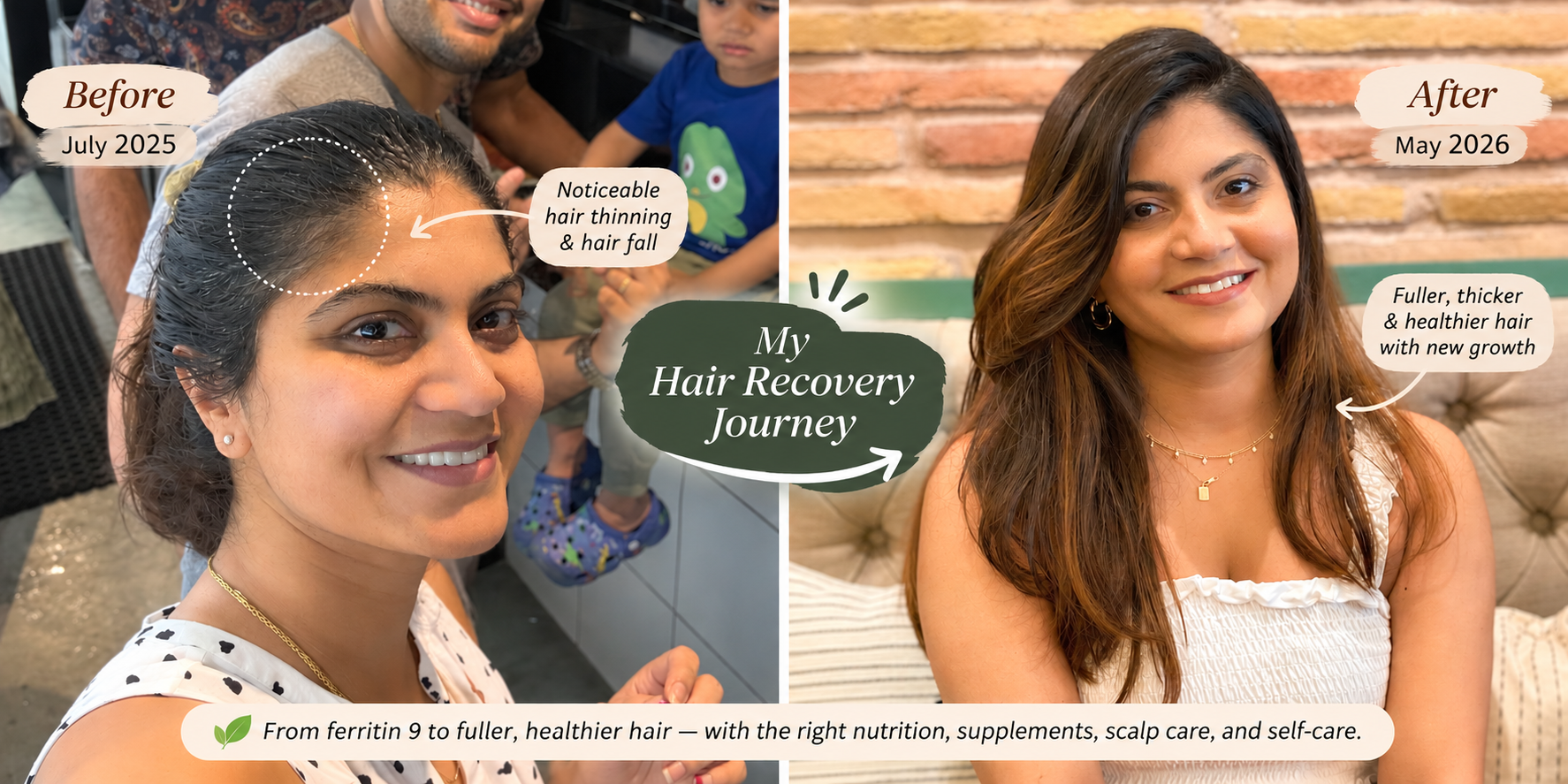
Extreme hair fall. Fatigue. Dizziness. Breathlessness. And a confidence that seemed to be slipping away in every area of my life.
I was raising a toddler and building my own business from scratch. I was ambitious, constantly on the go, and telling myself that being exhausted was just part of the season of life I was in. But this felt different.
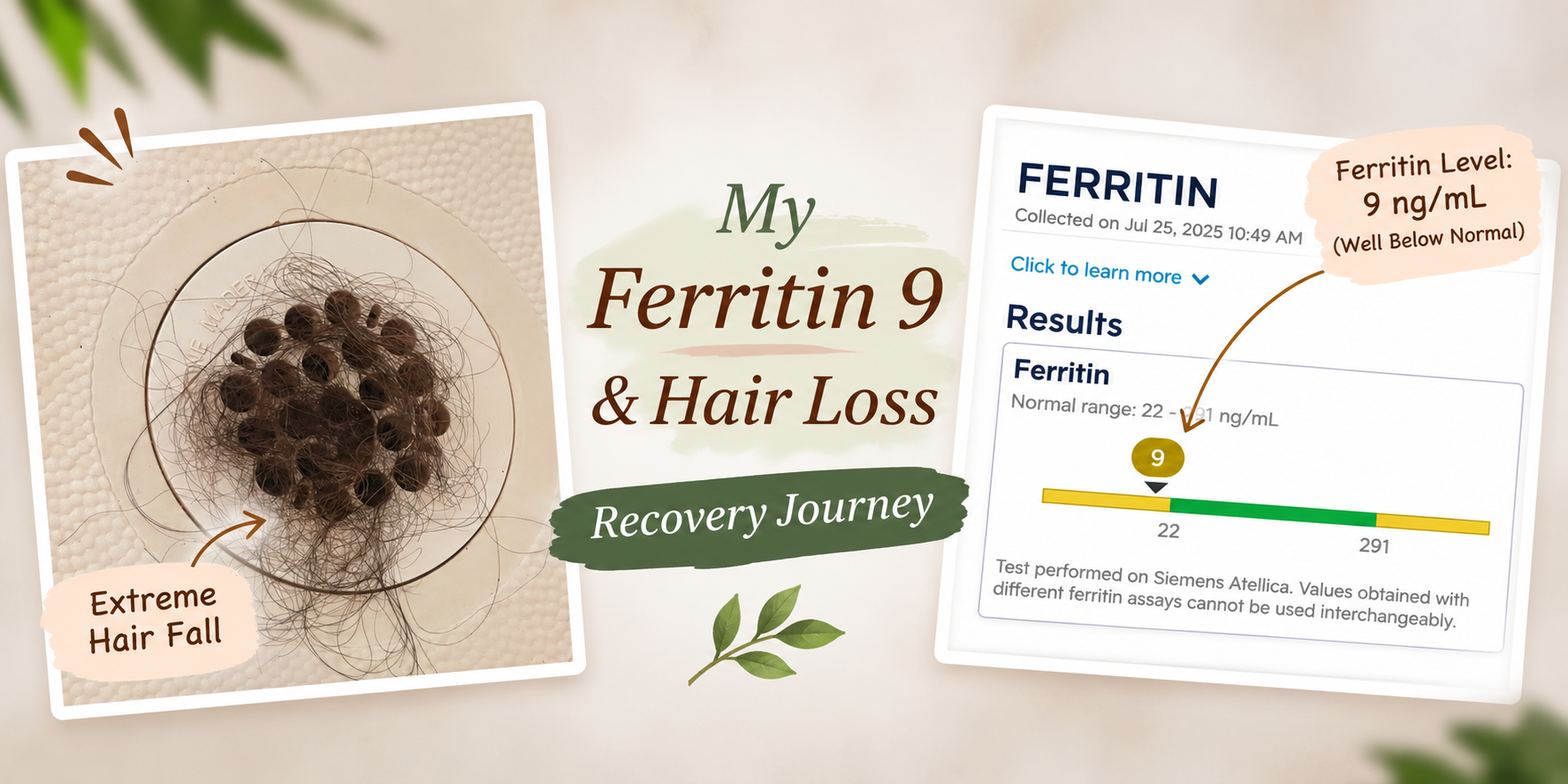
Eventually, my bloodwork showed a ferritin level of 9 ng/mL. This is the story of what I did next, and what I wish I’d understood sooner.
The First Time I Heard About Ferritin, It Wasn’t Even About Me
It was at my son’s one-year checkup. His pediatrician said his ferritin was low and recommended iron drops. I was puzzled: his hemoglobin was normal, and the other iron numbers I’d seen looked fine. Why did he need a supplement?
She explained that ferritin is a protein that stores iron, a way of measuring the body’s iron reserves. I preferred getting nutrients through food whenever possible, and I was hesitant about giving my little one supplements. Looking at my otherwise happy, healthy toddler, I didn’t take the recommendation as seriously as I should have.
A year or two later, that same word became a huge part of my own life. Going through low ferritin myself changed my perspective. I became more diligent about following his pediatrician’s guidance, because I didn’t want to overlook an iron deficiency just because someone appeared healthy. Children need their own medical evaluation and dosing, not an adult’s supplement routine.
When my body started sending warning signs
Hair fall was the first thing I couldn’t ignore. Every wash left a huge ball of hair in the sink. Even on non-wash days, combing brought out handfuls. I’d seen postpartum shedding before, but never anything like this.
- Extreme shedding: My once-thick hair looked visibly thinner.
- Fatigue: Normal household tasks left me depleted.
- Dizziness: I’d feel lightheaded after doing everyday work.
- Breathlessness: Sometimes I’d run out of breath while simply talking, even without congestion or a cold.
- Low self-esteem: Not just because of my hair. I was trying to build a business, raise a toddler, and meet ambitious goals, yet felt I was failing to do enough. That feeling spread across my work, motherhood, and sense of self.
It wasn’t simply the usual exhaustion of being a mom. Something felt genuinely wrong. Seeing ferritin: 9 on my results finally gave me a reason to investigate further with my doctor.
Low ferritin can occur even when hemoglobin is normal. Breathlessness, dizziness, and fatigue can also indicate other conditions, so they should not automatically be attributed to ferritin alone.
NOURISH: Rebuilding From Within
My first priority was addressing the underlying deficiency with medical guidance. Finding an iron supplement I could actually tolerate turned out to be its own journey.
1. Ferrous sulfate: I couldn’t tolerate it
This was the first option I tried, and it’s commonly recommended in the US. Almost immediately, I felt dramatically worse: nausea, weakness, and feeling so unwell that driving and carrying on with normal activities became difficult. I stopped after two days.
Pros: Affordable, widely available, and effective for many people. Cons: It can cause nausea, constipation, stomach pain, or other digestive side effects. My verdict: Not sustainable for me, though it may work perfectly well for someone else.
2. Softeron Gold: The first one I could stick with
I reached out to my doctor in India, who recommended Softeron Gold. It contains Lipofer iron (a formulation using ferric pyrophosphate), along with vitamin C, B12, and folic acid. I took it for about four months.
What a difference! I didn’t experience the nausea or gut issues that I’d had with ferrous sulfate, and my follow-up ferritin results improved. For me, this was the first supplement that made consistency possible.
Pros: Personally well tolerated; my bloodwork improved. Cons: May be difficult to obtain outside India; formulations and individual responses vary.
See Softeron Gold’s official formulation →
3. SiderAL Forte: Expensive, but worked for me
Later I discovered SiderAL Forte by PharmaNutra through a creator I trusted. It uses Sucrosomial® iron, a specialized formulation designed to support iron delivery and tolerability. I felt good taking it, didn’t notice the same digestive discomfort, and my ferritin continued improving.
I couldn’t literally feel how much iron was being absorbed, and I can’t prove this supplement alone caused the improvement. But I could tolerate it, which mattered enormously. The drawback? It’s expensive!
The linked US 30 mg formulation also includes vitamin C, so I wouldn’t automatically add extra vitamin C without checking the label and my doctor’s advice.
View the exact SiderAL supplement
| Supplement | My experience | Tradeoff |
|---|---|---|
| Ferrous sulfate | Stopped after two days due to severe symptoms | Affordable, but poorly tolerated by me |
| Softeron Gold | About four months; ferritin improved | Worked for me; India availability |
| SiderAL Forte | Comfortable to take; ferritin continued improving | High price |
These are personal experiences, not head-to-head clinical results. Never change the dose or switch iron products without checking the elemental iron amount and consulting your clinician. Excess iron is harmful.
How I took my iron
I made a habit of having an orange or orange juice around the time I took my supplement. Vitamin C can help with absorption of non-heme iron, although extra vitamin C is not essential with every formulation.
I also tried to separate conventional iron supplements from tea, coffee, and calcium-rich foods or supplements, which can interfere with absorption when consumed together. My general habit was a roughly two-hour gap, but the right timing depends on the particular supplement and any other medicines you’re taking.
The other thing I started watching: Protein
At one point, some of my iron-related blood markers were moving in the right direction while my ferritin still seemed stubbornly low. As I read more, I learned that ferritin is an iron-storage protein. That made me look more closely at my own protein intake.
Being a vegetarian and a toddler mom, I wasn’t always getting intentional protein at every meal. So I started focusing on three daily habits: iron, vitamin C-rich foods, and enough protein.
Vegetarian foods I kept coming back to
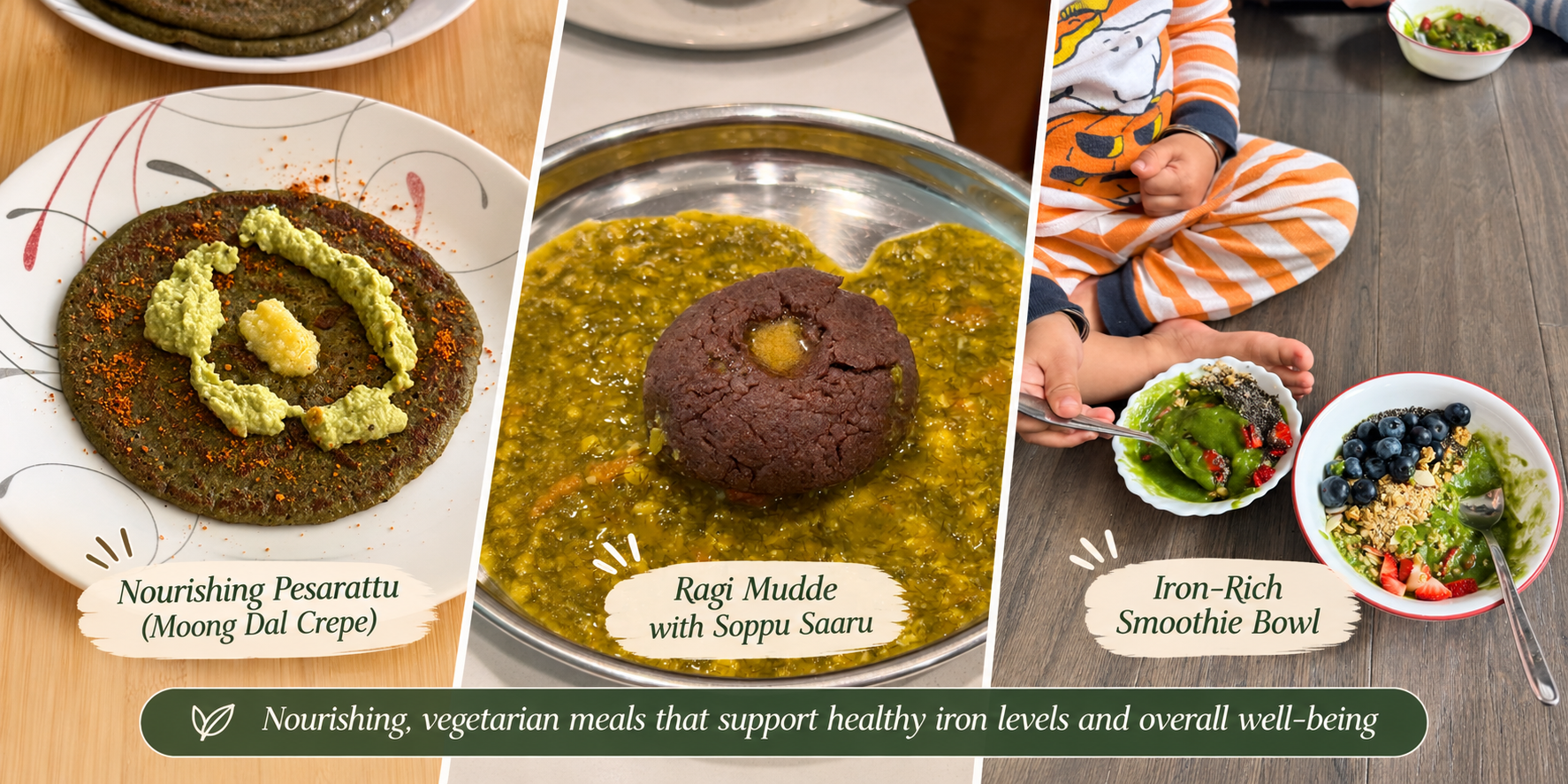
Pesarattu (green moong dosa): My favorite easy breakfast. Soak 1.5 cups dry whole green moong overnight. Blend with ginger, curry leaves, cumin, salt, and water; spread into six dosas and cook on both sides. Add onion, coriander, or green chili if you like. The whole dry batch has roughly 70–75 g protein, or around 12 g per dosa if you make six equal portions. The actual amount depends on your ingredients and yield.
Boiled eggs: I’m usually vegetarian without eggs, but I added them occasionally because two eggs offer about 12–13 g protein with almost no prep. Salt, pepper, and yes, a little ketchup if the smell bothers you!
Palak dal and spinach: Easy to work into meals. I loved adding lemon or lime just before eating for a vitamin C boost. Spinach contains iron, though not all of it is readily absorbed.
Moringa leaves and drumsticks: Great additions to familiar Indian recipes. The leaves and pods have different nutrient profiles, so I don’t treat them as interchangeable iron sources.
Ragi mudde and ragi roti: Comforting finger millet staples, delicious with dal, sambar, or a rich vegetable gravy.
Tofu, paneer, and soya chunks: Convenient ways to make meals more protein-rich. I rotated them instead of relying on a single food.
One simple sample day
| Breakfast | Two pesarattus, chutney, and guava or orange |
|---|---|
| Lunch | Palak dal, rice, vegetable sabzi, and fresh lemon |
| Snack | Roasted chana or nuts |
| Dinner | Tofu or soya chunks curry with ragi roti |
This isn’t a prescribed meal plan. It’s simply the kind of practical, repeatable eating that helped me be more intentional. Restoring iron stores often takes months, and follow-up bloodwork matters more than guessing from symptoms alone.
NURTURE: Caring for My Hair While My Body Recovered
Even while I was addressing my ferritin, the shedding didn’t stop overnight. I wanted to do something loving for my hair instead of feeling helpless every wash day.
My twice-weekly Scalp Kalpa ritual
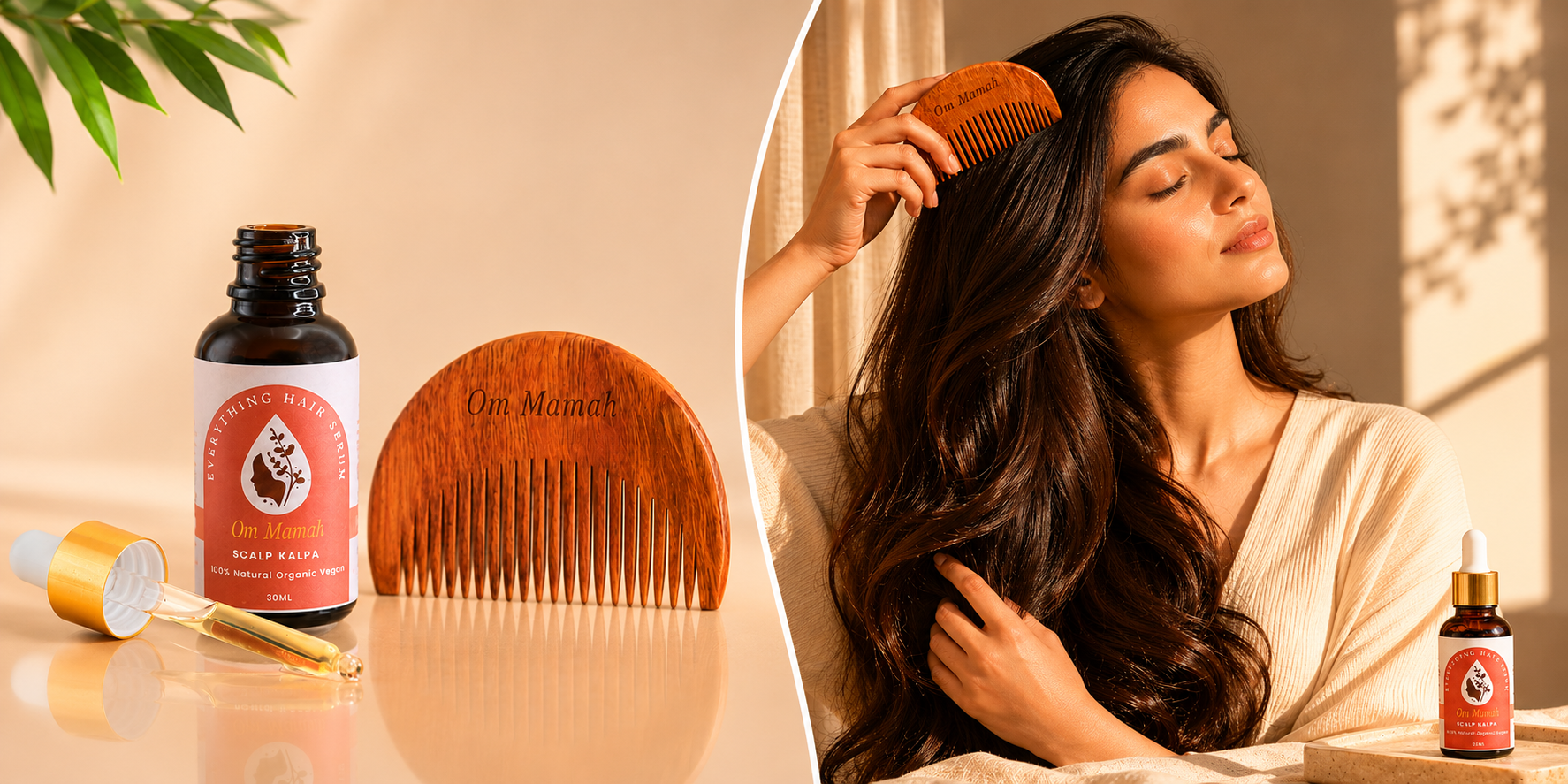
At least twice a week, I applied Om Mamah Scalp Kalpa 2-in-1 Hair Serum before bed and massaged my scalp gently for two to five minutes. The botanical aroma was deeply relaxing after a long day. I’d leave it overnight and wash my hair the following morning.
Over time I began noticing baby hairs, which was such a hopeful feeling while the shedding was still happening. I can’t separate the effect of the serum from my natural hair cycle or nutritional recovery, but this ritual was one of the ways I cared for myself consistently.
Why I switched to a neem comb
I paired the serum with a neem wooden comb, using it gently to distribute oil and massage my scalp. Eventually I switched from plastic for everyday combing, too. My hair felt smoother, with less static and frizz, and combing became a small calming ritual instead of a chore.
🌿 Shop my exact scalp-care routine
Scalp Kalpa 2-in-1 Hair Serum
My twice-weekly pre-wash scalp massage ritual.
2-in-1 Frizz-Free Neem Comb
My full-size comb for gentle oil distribution, detangling, and styling.
Travel-Friendly Neem Comb
A compact option for my handbag and on-the-go touch-ups.
A little transparency: Scalp Kalpa and the Neem Combs are products from my own brand, Om Mamah. I personally formulate and use these products, and I’m sharing the role they’ve played in my hair-care journey. They are cosmetic hair-care products, not treatments for iron deficiency or medically diagnosed hair loss.
Abhyanga during my hardest month
One memory stands out: April 2025, during a trip to India. My breathlessness felt especially overwhelming. I wasn’t congested or sick, yet talking could leave me struggling to catch my breath.
During that period, I started practicing Abhyanga, a traditional Ayurvedic oil massage. I bought edible-grade almond oil and gently massaged my arms and legs. Sometimes I noticed a little burping afterward, followed by a feeling that my breathing was easier.
I don’t know whether the massage caused that sensation or why it happened. What I do know is that those quiet minutes were comforting when I felt physically overwhelmed. Abhyanga became a relaxation ritual for me, not a treatment for breathlessness. Please don’t use massage instead of seeking medical care for breathing symptoms.
RESTORE: The Mental Health Side of My Recovery
When my symptoms became extreme, I was also running on overdrive. I was ambitious, building something from nothing, parenting a toddler, and carrying the emotional weight of pregnancy, postpartum life, and working full-time.
There was always another goal, another task, another way I thought I should be doing better. My low self-esteem wasn’t only about my hair. It was a feeling of not measuring up, even while doing an enormous amount.
I was working so hard to build a life I loved that I wasn’t always giving myself space to live it.
I can’t say stress caused my low ferritin. But burnout can affect sleep, mood, and energy, and significant stress can contribute to some forms of hair shedding. So I started caring for my mind alongside my body.
- Journaling: Helped me notice when I was spiraling into worry or self-criticism.
- Yoga: Gave me a reason to slow down and reconnect with my body.
- Meditation: Helped me observe thoughts without feeling I had to act on every one.
None of these replaced medical care. They helped me get through a difficult season with more kindness toward myself.
What I Wish I’d Known Sooner
- Don’t dismiss persistent symptoms. Hair loss, dizziness, fatigue, and breathlessness deserve proper evaluation.
- Normal hemoglobin doesn’t always mean iron stores are adequate. Ask your clinician which tests make sense.
- Iron supplements aren’t one-size-fits-all. If one causes side effects, discuss a different formulation or schedule.
- Pay attention to the whole diet. Iron, vitamin C-rich foods, and adequate protein all have different roles.
- Consistency and follow-up testing matter. Don’t assume your ferritin is fixed because you feel a little better.
- Make room for care, not just achievement. Scalp rituals, journaling, yoga, and rest helped me feel grounded.
I started this journey desperately trying to get my hair back. But somewhere along the way, I realized I needed to take better care of the woman who was trying to do it all.
Taking care of yourself isn’t something you earn after achieving your goals. It’s what helps you keep showing up for the life you’re building.
With love,
Aparna
Founder, Om Mamah
A Mother’s Heart. An Engineer’s Precision. Ayurveda’s Wisdom.
Interested in a 90-day hair wellness journey?
I’m exploring a practical, vegetarian-friendly program focused on nourishing food, gentle scalp rituals, and mindful habits alongside appropriate medical care.
Coming soon: Waitlist link will be added here.
Medical disclaimer and further reading
This post describes my personal experience and research. It is for education only and is not medical advice. Iron deficiency, hair shedding, dizziness, fatigue, and shortness of breath have multiple possible causes. Consult a qualified healthcare professional for diagnosis, appropriate iron dosing, and monitoring. Iron overdose can be dangerous, particularly for children; store supplements securely. Persistent breathlessness warrants prompt medical evaluation, and sudden or severe breathing difficulty, chest pain, or fainting requires urgent care. Cosmetic products and massage do not treat iron deficiency or anemia. Individual results vary.
Further reading: NIH Office of Dietary Supplements: Iron · MedlinePlus: Taking Iron Supplements